 Add to Chrome
 Add to Firefox
 Add to Edge
Plant, Persist, Trigger: Sleeper Attack on Large Language Model Agents
May 27, 2026
Large Language Model (LLM) agents remain vulnerable to safety threats from the external environment, where attackers inject adversarial content into external observations such as tool-returned data, webpages, or MCP context, causing harmful agentic behaviors such as unsafe actions or incorrect outputs. Existing studies typically focus on single-interaction attacks, where the agent observes adversarial content and immediately exhibits harmful behavior within one user request. However, we show that adversarial content can also persist across interactions served by the same agent, making such threats harder to detect and mitigate. Specifically, adversarial content may persist in the agent state, remain dormant across interactions, and later be activated by a benign user query. We formalize this type of safety threat as Sleeper Attack. To evaluate it, we construct a benchmark with 1,896 instances covering six real-world harmful outcomes, three attack strategies, and three agent state targets: session context, memory, and reusable skills. Experiments on seven strong open-source and closed-source LLMs show that state-of-the-art LLM agents remain vulnerable to Sleeper Attack, even when they achieve low attack success rates under a single-interaction baseline. Our code and data are available at https://anonymous.4open.science/r/skdvnfu23ihr9wdscnksf1asdffsaef.

ARES: Automated Rubric Synthesis for Scalable LLM Reinforcement Learning
May 25, 2026Rubric-based rewards offer a promising way to extend reinforcement learning (RL) for large language models beyond tasks with automatically verifiable answers. However, scaling rubric-based RL remains challenging: existing approaches often rely on expert-written rubrics and manually constructed question sets, while fixed task-level rubrics may fail to capture the evaluation requirements of individual questions. We propose ARES (Automated Rubric synthEsis for Scalable RL), a framework for automatically constructing rubric-based RL data at scale. Starting from raw pretraining documents, ARES converts source knowledge into self-contained question-answer pairs and co-generates question-specific weighted rubrics, enabling instance-level reward supervision for open-ended responses. To improve diversity and quality, ARES conditions generation on domain labels and persona information, and applies validation filters for question self-containment, answer faithfulness, and rubric validity. Using ARES, we construct 100K rubric-annotated instances across ten domains. Experiments on seven benchmarks show that rubric-based RL trained with ARES, outperforms continual pretraining, supervised fine-tuning, and binary-reward RL, with the largest gains on multi-dimensional open-ended tasks such as healthcare and instruction following.
SkillGraph: Skill-Augmented Reinforcement Learning for Agents via Evolving Skill Graphs
May 12, 2026Skill libraries enable large language model agents to reuse experience from past interactions, but most existing libraries store skills as isolated entries and retrieve them only by semantic similarity. This leads to two key challenges for compositional tasks. Firstly, an agent must identify not only relevant skills but also how they depend on and build upon each other. Secondly, it also makes library maintenance difficult, since the system lacks structural cues for deciding when skills should be merged, split, or removed. We propose SKILLGRAPH, a framework that represents reusable skills as nodes in a directed graph, with typed edges encoding prerequisite, enhancement, and co-occurrence relations. Given a new task, SKILLGRAPH retrieves not just individual skills, but an ordered skill subgraph that can guide multi-step decision making. The graph is continuously updated from agent trajectories and reinforcement learning feedback, allowing both the skill library and the agent policy to improve together. Experiments on ALFWorld, WebShop, and seven search-augmented QA tasks show that SKILLGRAPH achieves state-of-the-art performance against memory-augmented RL methods, with especially large gains on complex tasks that require composing multiple skills.
SAGE: Scalable Automated Robustness Augmentation for LLM Knowledge Evaluation
May 12, 2026Large Language Models (LLMs) achieve strong performance on standard knowledge evaluation benchmarks, yet recent work shows that their knowledge capabilities remain brittle under question variants that test the same knowledge in different forms. Robustness augmentation of existing knowledge evaluation benchmarks is therefore necessary, but current LLM-assisted generate-then-verify pipelines are costly and difficult to scale due to low-yield variant generation and unreliable variant verification. We propose SAGE (Scalable Automated Generation of Robustness BEnchmarks), a framework for scalable robustness augmentation of knowledge evaluation benchmarks using fine-tuned smaller models. SAGE consists of VariantQual, a rubric-based verifier trained on human-labeled seed data, and VariantGen, a variant generator initialized with supervised fine-tuning and further optimized with reinforcement learning using VariantQual as the reward model. Experiments on HellaSwag show that SAGE constructs a large-scale robustness-augmented benchmark with quality comparable to the human-annotated HellaSwag-Pro at substantially lower cost, while the fine-tuned models further generalize to MMLU without benchmark-specific fine-tuning.
On Predicting the Post-training Potential of Pre-trained LLMs
May 12, 2026The performance of Large Language Models (LLMs) on downstream tasks is fundamentally constrained by the capabilities acquired during pre-training. However, traditional benchmarks like MMLU often fail to reflect a base model's plasticity in complex open-ended scenarios, leading to inefficient model selection. We address this by introducing a new task of predicting post-training potential - forecasting a base model's performance before post-training. We propose RuDE (Rubric-based Discriminative Evaluation), a unified framework that bypasses the generation gap of base models by leveraging response discrimination. Guided by our systematic 4C Taxonomy, RuDE constructs controlled contrastive pairs across diverse domains by fine-grained rubric violations. Extensive experiments demonstrate a correlation greater than 90% with post-training performance. Crucially, validation via Reinforcement Learning (RL) confirms that RuDE effectively identifies high-potential smaller models that outperform larger counterparts, offering a compute-efficient mechanism for foundation model development.
RL-MTJail: Reinforcement Learning for Automated Black-Box Multi-Turn Jailbreaking of Large Language Models
Dec 08, 2025Large language models are vulnerable to jailbreak attacks, threatening their safe deployment in real-world applications. This paper studies black-box multi-turn jailbreaks, aiming to train attacker LLMs to elicit harmful content from black-box models through a sequence of prompt-output interactions. Existing approaches typically rely on single turn optimization, which is insufficient for learning long-term attack strategies. To bridge this gap, we formulate the problem as a multi-turn reinforcement learning task, directly optimizing the harmfulness of the final-turn output as the outcome reward. To mitigate sparse supervision and promote long-term attack strategies, we propose two heuristic process rewards: (1) controlling the harmfulness of intermediate outputs to prevent triggering the black-box model's rejection mechanisms, and (2) maintaining the semantic relevance of intermediate outputs to avoid drifting into irrelevant content. Experimental results on multiple benchmarks show consistently improved attack success rates across multiple models, highlighting the effectiveness of our approach. The code is available at https://github.com/xxiqiao/RL-MTJail. Warning: This paper contains examples of harmful content.
MTR-Bench: A Comprehensive Benchmark for Multi-Turn Reasoning Evaluation
May 26, 2025Recent advances in Large Language Models (LLMs) have shown promising results in complex reasoning tasks. However, current evaluations predominantly focus on single-turn reasoning scenarios, leaving interactive tasks largely unexplored. We attribute it to the absence of comprehensive datasets and scalable automatic evaluation protocols. To fill these gaps, we present MTR-Bench for LLMs' Multi-Turn Reasoning evaluation. Comprising 4 classes, 40 tasks, and 3600 instances, MTR-Bench covers diverse reasoning capabilities, fine-grained difficulty granularity, and necessitates multi-turn interactions with the environments. Moreover, MTR-Bench features fully-automated framework spanning both dataset constructions and model evaluations, which enables scalable assessment without human interventions. Extensive experiments reveal that even the cutting-edge reasoning models fall short of multi-turn, interactive reasoning tasks. And the further analysis upon these results brings valuable insights for future research in interactive AI systems.
Assistant-Guided Mitigation of Teacher Preference Bias in LLM-as-a-Judge
May 25, 2025LLM-as-a-Judge employs large language models (LLMs), such as GPT-4, to evaluate the quality of LLM-generated responses, gaining popularity for its cost-effectiveness and strong alignment with human evaluations. However, training proxy judge models using evaluation data generated by powerful teacher models introduces a critical yet previously overlooked issue: teacher preference bias, where the proxy judge model learns a biased preference for responses from the teacher model. To tackle this problem, we propose a novel setting that incorporates an additional assistant model, which is not biased toward the teacher model's responses, to complement the training data. Building on this setup, we introduce AGDe-Judge, a three-stage framework designed to debias from both the labels and feedbacks in the training data. Extensive experiments demonstrate that AGDe-Judge effectively reduces teacher preference bias while maintaining strong performance across six evaluation benchmarks. Code is available at https://github.com/Liuz233/AGDe-Judge.
Self-Improvement Towards Pareto Optimality: Mitigating Preference Conflicts in Multi-Objective Alignment
Feb 20, 2025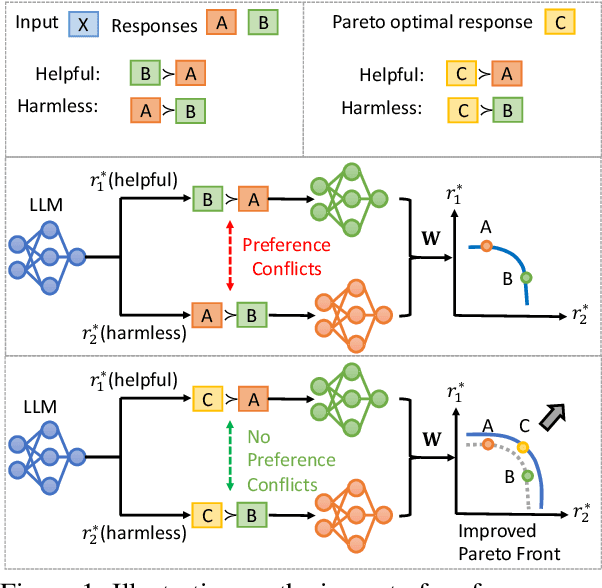
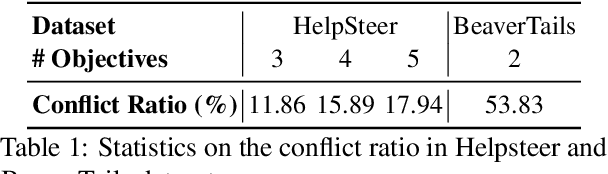
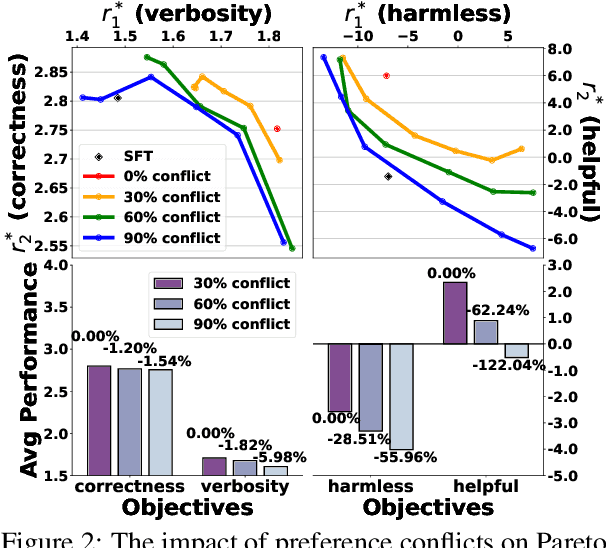
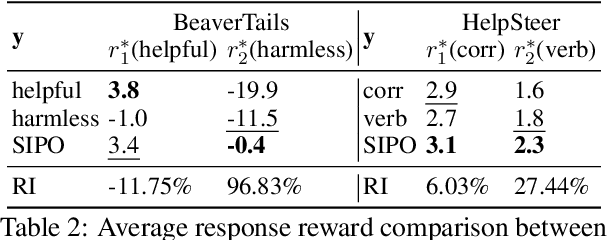
Multi-Objective Alignment (MOA) aims to align LLMs' responses with multiple human preference objectives, with Direct Preference Optimization (DPO) emerging as a prominent approach. However, we find that DPO-based MOA approaches suffer from widespread preference conflicts in the data, where different objectives favor different responses. This results in conflicting optimization directions, hindering the optimization on the Pareto Front. To address this, we propose to construct Pareto-optimal responses to resolve preference conflicts. To efficiently obtain and utilize such responses, we propose a self-improving DPO framework that enables LLMs to self-generate and select Pareto-optimal responses for self-supervised preference alignment. Extensive experiments on two datasets demonstrate the superior Pareto Front achieved by our framework compared to various baselines. Code is available at \url{https://github.com/zyttt-coder/SIPO}.
HellaSwag-Pro: A Large-Scale Bilingual Benchmark for Evaluating the Robustness of LLMs in Commonsense Reasoning
Feb 17, 2025Large language models (LLMs) have shown remarkable capabilities in commonsense reasoning; however, some variations in questions can trigger incorrect responses. Do these models truly understand commonsense knowledge, or just memorize expression patterns? To investigate this question, we present the first extensive robustness evaluation of LLMs in commonsense reasoning. We introduce HellaSwag-Pro, a large-scale bilingual benchmark consisting of 11,200 cases, by designing and compiling seven types of question variants. To construct this benchmark, we propose a two-stage method to develop Chinese HellaSwag, a finely annotated dataset comprising 12,000 instances across 56 categories. We conduct extensive experiments on 41 representative LLMs, revealing that these LLMs are far from robust in commonsense reasoning. Furthermore, this robustness varies depending on the language in which the LLM is tested. This work establishes a high-quality evaluation benchmark, with extensive experiments offering valuable insights to the community in commonsense reasoning for LLMs.